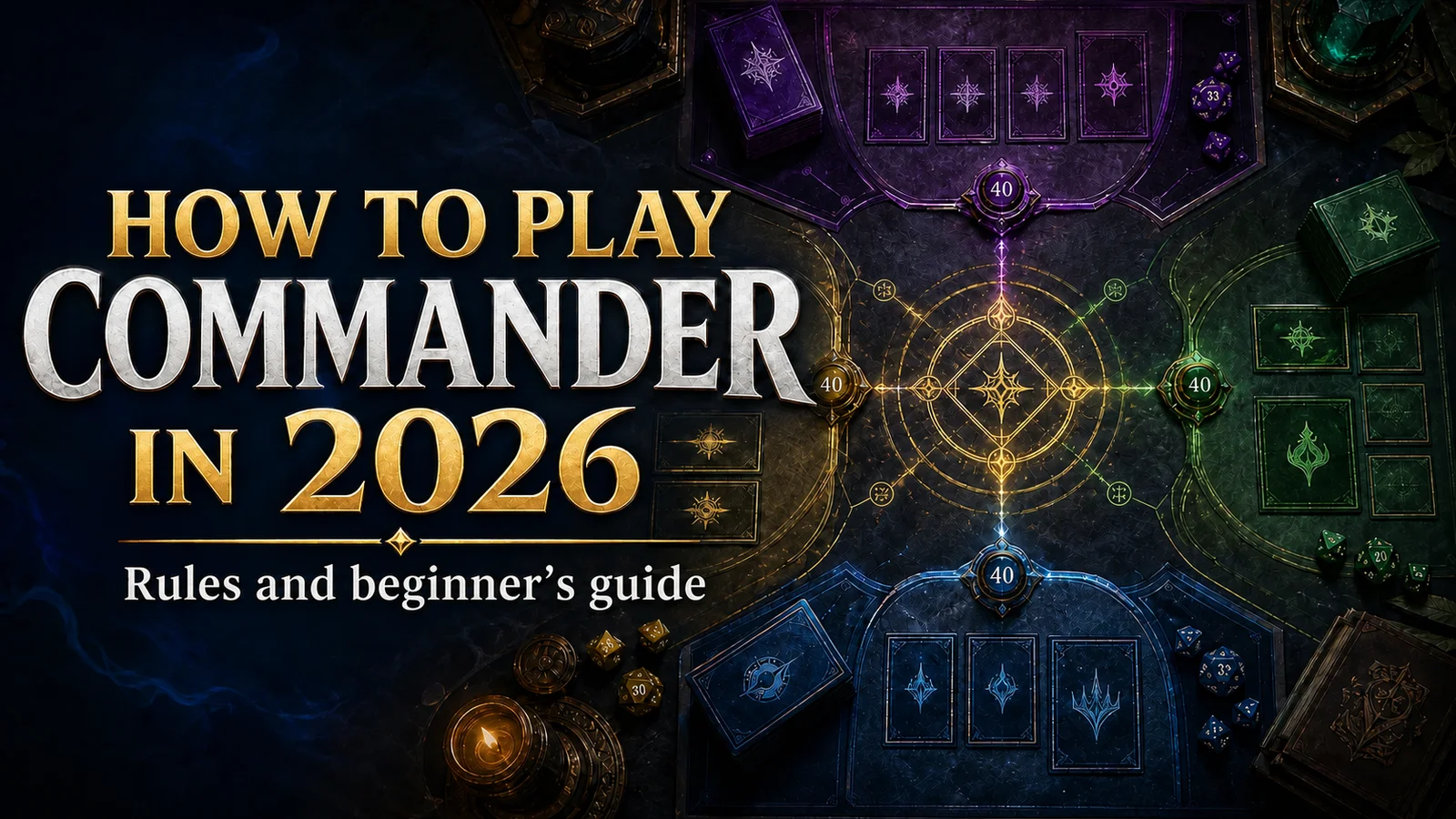
How to play Commander in 2026: the essentials
If you know Magic’s basic rules but not how to play Commander, the good news is that the format is easier to learn than it looks. Turns work as in normal Magic; the differences are deck construction, player count, starting life and the commander’s role.
Commander — also called EDH — is usually a four-player free-for-all. Each player chooses a legendary card as their commander and builds around its colours and abilities.
This guide teaches how to play Commander step by step, what you need for your first game and the special rules to remember in 2026.
Commander rules explained simply
These are the rules you need before sitting down to play:
- Exactly 100 cards: 99 in your library and 1 commander in the command zone; with two permitted commanders, 98 and 2
- Singleton format: one copy of each card, except basic lands
- Colour identity: no card may have colours or mana symbols outside your commander’s identity
- 40 starting life: each player begins with 40 life
- Seven-card hand: draw seven cards to start
- Multiplayer game: usually four players, although three to five can play
- 21 commander damage: you lose if one commander deals you 21 combat damage during the game
- Last player standing: whoever makes all opponents lose wins
Step 1: choose your commander
Your commander is usually a legendary creature. It starts face up in a separate area called the command zone, so you always know you can access that card.
The commander serves two roles:
- Defines deck colours. If your commander is red and green, you can only include red, green, red-green or colourless cards.
- Sets your strategy. Its abilities usually indicate whether the deck wants to play Dragons, sacrifice creatures, gain life, cast many spells or attack with one large creature.
Step 2: prepare a 100-card deck
One common question is how many cards Commander requires. The answer is exactly 100 including the commander.
There is no mandatory ratio, but this foundation works well to start:
- 36 to 38 lands
- 10 cards generating additional mana
- 10 cards drawing or generating advantage
- 8 to 12 answers to destroy, exile or counter threats
- 2 to 4 board wipes, depending on the deck’s style
- The remaining cards develop the main strategy
To start without building from scratch, browse our budget 100-card Commander lists — currently being restocked — or request a custom Commander deck for your budget.
Step 3: set up and start the game
Each player shuffles their 99 cards, leaves the commander visible in the command zone and sets a life counter to 40. Randomly decide who starts, then everyone draws seven cards.
Before the first turn, have a quick conversation about:
- Each deck’s strategy
- The table’s expected power level
- Infinite combos, extra turns or particularly decisive cards
- Whether the game should be relaxed or competitive
Before the first turn: mulligans and example hands
In multiplayer Commander, the first mulligan does not reduce your hand. Shuffle and draw seven again. For further mulligans, when you keep, put one card on the bottom for each mulligan after the first. At the usual four-player table, the starting player also draws on their first turn. Do not confuse this with two-player rules.
These exercises describe hypothetical hands in a mid-cost green deck. They are reasoned learning decisions, not test results or advice for every list. Open each answer after choosing.
Hand A: three Forests, a two-mana ramp card, three-mana draw, a two-mana answer and a four-mana creature. Keep?
In this deck, usually yes: you have lands, early plays and a way to keep gaining resources. Always check that the actual cards produce or require the mana you need and that the plan fits the table.
Hand B: one Forest and six spells costing four or more. Keep?
I would normally mulligan. There is no early play or ramp, and you depend too much on upcoming draws. In multiplayer, take advantage of the free first mulligan.
Hand C: six Forests and a seven-mana creature with no draw ability. Keep?
For this example, I would seek another hand: lands are not enough without a plan in the early turns. A specific land-focused list might change the decision.
Your table sheet: life, damage and tax
Track life and combat damage from each commander separately. If someone plays two commanders, they need two separate tallies.
| What to track | Example | Meaning |
|---|---|---|
| Your life | 28 | This is not your commander damage tally |
| Damage from commander A | 12 | Continues accumulating even when you gain life |
| Damage from commander B | 9 | Does not combine with A to reach 21 |
| Casts of your commander from the command zone | 2 | Its next cast from there costs an additional {4} |
You can print the Magic and Commander reference sheet, which includes spaces for these tallies.
Step 4: take turns as in normal Magic
Commander turns retain Magic’s usual phases:
1. Beginning phase
Untap your cards, resolve upkeep effects and draw a card.
2. First main phase
You may play a land — at most one per turn unless a card permits more — and cast creatures, artifacts, enchantments and other spells.
3. Combat phase
Choose attacking creatures and which player or planeswalker each attacks. In Commander, you can split attacks among several opponents.
4. Second main phase
Play cards saved until after combat.
5. Ending phase
End-of-turn effects resolve and, if you have more than seven cards in hand, you normally discard down to seven.
Turns pass clockwise. With multiple opponents, keep some mana to respond during their turns: spending resources too early can leave you defenceless for three consecutive turns.
How the command zone and commander tax work
You can cast your commander from the command zone for its normal cost. If it reaches the graveyard or exile, you may move it to the command zone the next time state-based actions are checked. If it would go to your hand or library, you may replace that move with the command zone. Returning there costs no mana itself.
Each time you cast it again from the command zone, pay two additional generic mana for each previous time you cast it from there. This is commander tax.
For example, if your commander costs four mana:
- First cast: 4 mana
- Second cast from the command zone: 6 mana
- Third cast: 8 mana
How to win a Commander game
The usual way to win is reducing every opponent’s life to zero. Magic’s other win and loss conditions also apply, but Commander adds an important one:
If you take 21 combat damage from the same commander, you lose the game, even with life remaining.
Track commander damage separately. Taking 12 from one commander and 9 from another does not total 21; it must come from the same commander. This lets Voltron strategies win by strengthening a single legendary creature.
Commander brackets in 2026
In 2026, five optional Commander Brackets describe the experience each deck seeks:
- Bracket 1 — Exhibition: thematic, creative, low-pressure experiences
- Bracket 2 — Core: social Commander with clear plans and restrained power
- Bracket 3 — Upgraded: improved, consistent decks with strong interaction
- Bracket 4 — Optimized: fast, powerful lists designed to finish efficiently
- Bracket 5 — cEDH: competitive Commander with fully optimised lists and decisions
As the system evolves, honestly explaining what your deck does remains the most reliable approach. To begin, seek a Bracket 1 or 2 table with players willing to teach.
Tips for your first Commander game
- Attack when safe: do not always wait for a perfect board; early damage counts
- Do not make one player your only target: Commander is social, and two other opponents remain
- Save answers: removal can stop another player winning
- Read cards aloud: help everyone understand what is happening
- Ask before assuming: interactions across four decks can be complex
- Do not hide your deck’s power: explaining combos and decisive cards improves the game
- Learn by playing: nobody knows every Commander card or rule
Common mistakes when learning Commander
Playing too few lands
A 100-card deck needs a stable mana base. Starting with 36–38 lands is usually safer than filling the list with spectacular spells you cannot cast.
Including good cards without a plan
A powerful card is not always good for your commander. Prioritise cards supporting the main strategy and working well together.
Spending your whole hand too quickly
At a four-player table, trading a card for one opponent’s threat can advantage the other two. Choose carefully when to intervene.
Forgetting how you will win
Drawing cards and generating mana do not help if the deck never finishes. Include several cards capable of converting advantage into victory.
What you need for your first Commander game
You can start with very little:
- A legal Commander deck
- Sleeves to protect cards
- A life counter or app
- Counters or dice to mark effects
- Three other people and a table
To compare options, read our guide to the best budget Commander decks for beginners.
FAQs about playing Commander
How many cards are in a Commander deck?
Exactly 100 cards: 99 in the library and the commander in the command zone.
Can you have more than one commander?
Normally you choose one. Some cards have abilities such as Partner, Friends forever or “Choose a Background”, allowing two commanders when their conditions are met.
How much life does each player have?
Each player starts with 40 life.
Does commander damage have to come from my own commander?
It need not be an opponent’s: your own commander can count if another player controls it and deals you combat damage. You lose after 21 or more from the same commander; track each separately.
Can two people play Commander?
Yes, although the usual experience and reference rules are designed for multiplayer tables. With two players, some cards and strategies change greatly in value.
Are Commander and EDH the same?
Yes. EDH means Elder Dragon Highlander, the format’s original community name.
Start your first game
You now know how to play Commander in 2026: choose a legendary creature, prepare 99 compatible cards, start at 40 life and use your commander to develop the deck’s plan.
Do not try to memorise every interaction first. Learn essential rules, find a similarly powered table and let your first game teach the rest.
You can browse reference Commander lists — with purchases temporarily paused — or request a custom proposal, confirming price and timing.
Rules reviewed: 4 September 2026. Check the updated official rules, especially mulligans, starting the game and section 903.